It’s Been Too Long

I haven’t written in ages, and that’s because of all the injuries. Well, really all the surgeries: ankle surgery in February 2014 and knee surgery in December 2014. I felt I had no right to write a blog about running when I couldn’t run. But as someone dear to me pointed out, “You can’t just stop writing because of that, that’s ridiculous.” Direct but true.

The more I thought about it, the more I realized people tend to come to me when they were injured: to figure out what was causing the pain, determine the injury, could they still run on it, how do you rehab it, how can you stretch your IT band? All those questions have a place here. I can’t tell you how many hours I spend looking up stuff, going to doctors, buying books, doing physical therapy, and figuring out everything through trial and error.

Not to mention, I haven’t stopped eating. This blog is also about celiac disease. I am still cooking and baking and going out to restaurants and traveling. And I still have celiac disease and continually learn more and more about it, finding new products or books or blogs that help me. And the occasional oops that always occurs.

Then I recalled the most important little thing we runners have in common: mind over matter. Running is sport that requires you to use your will and your drive to push yourself to places that your brain tells you you cannot go. If you haven’t ever experienced this yet, you will, just give it time and don’t give up. It also becomes a source of stress relief, for all the things we face in life. It’s our “me” time. Its the place we go to reflect on the day and about life overall. I have made some of my biggest decisions and had some of my greatest revelations on my runs.

Trouble is, when you are injured, oh jeez, you have to figure out a new venue for all of these things and it is not easy. You feel like you lost your inner peace, the one thing you always felt progress in, and even your friend. Yes, when I can’t run, I get really discouraged. It is a struggle. It sounds trite to those who don’t understand running like this, but I can assure you, if you lost your coping mechanism and the reliable thing that made you feel good about yourself, you’d hit a wall as well.

Ultimately I forgot. When you are injured, that’s the time you need encouragement the most. Whether it’s the shin splits that has you benched for a month, the sprained ankle that made you miss your half marathon, or the debilitating news of surgery and months of physical therapy afterwards. It’s when you take one step forward and two steps back on that uncertain road to recovery. That’s when we need to know we are making progress, we have to take it slow, and we will get back to what sets our hearts on fire (or at least mine): running.
The Surgery: Under the Knife

I’m just going to give the rundown on what I experienced and hopefully it will give you an idea of what to expect if you have ankle ligament reconstruction surgery (*Please note: check with your doctor on all procedures and recommendations):

Someone has to be present the whole time so the surgery center ensures you will not drive yourself home. So my family and I arrived at the outpatient surgery center at 9am and full out paperwork. They called me back about 9:30am, while my family waited in the waiting room (to be called back later). They took me to a nurses station to be weighed, asked me what surgery I was having and which ankle ( they ask this a lot) and i asked for one last bathroom break.

I followed the nurse down a hall with lots of bed bays with a curtain front. She took me to my own bay and asked my name and birthdate and surgery questions again. Then I had to get undressed, put on a gown, and place all my belongings in a plastic bag they provided. I laid down on the bed and waited for the nurse to return. She started my IV (stuck me with a needle that was connected through a tube to a bag and taped it to my forearm).
Then another nurse came in, asked me about the surgery, and took my left ankle. She placed a pad underneath it and washed it with an organe-ish soap to have it clean for surgery (leaves a yellowish residue).

I then met an anesthesiologist, who asked about my surgery again. He asked if I wanted a nerve block (which my Dr. recommended). Basically this dulls the nerve that goes down into your lower leg and foot. This was a great thing because it enabled me to sleep for two days after surgery before I felt the real pain. I agreed to have it done, and he left to get his things prepped.

Next, the anesthesiologist’s assistant came in and began setting up equipment. The anesthesiologist returned and the nurse over my IV gave me something to relax. Immediately I felt drowsy and things got a little fuzzy. The anesthesiologist, using a marker, went up from my knee, to the outer thigh and marked the injection spot for the nerve block. A pinch lasted about five seconds as he injected the nerve block in with a large needle. It felt sore, but the medicine they gave me through the IV had dulled my senses.

At this point, the first nurse went to bring my family back for one last hello. I was starting to become more out of it at this point. After about three minutes, the family had to go because the anesthesiologist was back and started to hook me up to the big drugs (anesthesia).

I recall lying on the bed and being wheeled down a hall, through a set of double doors, and eventually to the surgery room. I think they asked me again what my surgery was and which leg (which is like going to happy hour then asked to calculate your annual income taxes). I then had to lift myself off the bed and scootch onto another “bed” (operating table). I know I saw my surgeon, she said hello. Then the anesthesiologist said he was giving me something, and I started to say, I think I feel it now, but only made it to “feel” before going unconscious.

Time passes, I have surgery ……

When I woke up, it was in a corridor with lots of other beds and patients starting to wake. My left foot felt snug, and appeared to be wrapped in a ace bandage with lots of padding underneath It was really a split cast: they cast the leg, then cut it all the way around it so the cast is literally split in half; the cast is tightened or loosened by an ace bandage wrapped around it.

A nurse came over and asked how my pain level was. I said, I didn’t really have any. She said when I had to wait a little while and when I felt awake enough, I could leave. I still felt half asleep and very wobbly 30 minutes later as a nurse unhooked me from the IV. Then they helped me get dressed, carefully getting my pants around my cast.

Then a wheelchair was brought to my bed, and a nurse wheeled me to a room where my family was waiting to take me home. A nurse went over everything that occurred during surgery as I was waking up, and I couldn’t remember any of it. So I was able to ask my family how it went (since the surgeon had spoken to them earlier after my surgery). Then the nurse wheeled me to the pick-up area and helped me into the car. I slept the remainder of the day and tired to have someone put ice on my ankle every 30 minutes.

The Solution: Lateral Ankle Ligament Reconstruction and Arthoscopy

January 2014: Second and Third Opinion from another Orthopedic Surgeon

After six months giving physical therapy a try and doing absolutely no running, my left ankle still wasn’t holding-up. I went to see another surgeon (we’ll call him Surgeon A), this time more prepared for the answer he gave. He went through and did the same things as the previous surgeon: another round of xrays and standing on one leg, etc. He also came to the same conclusion, that although no issues showed up on any of the tests, I probably needed surgery on my ankle to make it better.

Surgeon A had a lot of experience and was highly sought after in my town, but he described the surgery to me as he was speaking into a tape recorder just under the speed an auctioneer would. In the middle, there was something said along the lines of, “and the patient understands there is a metal suture that I will not remove post op.” I stopped him right there and asked if that meant that a piece of metal would be lodged in my ankle for the rest of my life. He said, yes, but it’s no more metal than that of an earring. Post op, I heard him dictate that I was to be in a non-weight bearing cast for three weeks, then a weight bearing cast for three more weeks, then a boot.  Despite not feeling comfortable to ask more questions, or go over what exactly the surgery entailed again more slowly, I went ahead and scheduled a date two months later for surgery (his first availability). I asked the nurse at the check-out counter what exactly the type of surgery I was going to have preformed: ankle ligament reconstruction and ankle scope. And off to Google it was to figure out what those meant.

After much time on the internet, I became more familiar with the procedure but still had questions and concerns. The first surgeon I saw, had recommended another surgeon if I decided later on that I wanted to do surgery. So, I decided for one last (my third) opinion from another orthopedic surgeon (Surgeon B).

Surgeon B was new to practice – only one year out of finishing her residency. She did not do any further xrays, after asking if anything had really changed since my last set of xrays, and I said no. She asked me to explain what happened and what my problems were and she listened. She sat me down on the table and took my ankle in her hand. She then began twisting and turning it, and then she pulled my ankle out and down. I heard a small pop. She did it again, and again another pop. She then explained that she could pull my ankle out of joint very easily and that was not normal. Believing more in clinically what she found than in test results, she explained how my ligament had become too lax and could not support the ankle joint staying in place all the time, and went through what surgery would do.

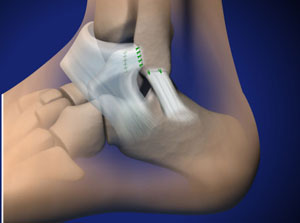
From my understanding, she would use a small camera to examine the inside of my ankle joint. This was to ensure that no small pieces of cartilage had chipped off at any point from all my ankle sprains, and was called an arthroscope. Thenlateral ankle ligament reconstruction, she would cut my lateral ankle ligament and suture it back together and take a portion of the ligament and suture it to the bone (with the placement of a small metal screw that would remain in my ankle). There would be a lot of scar tissue that would form around the cut and it was one time that scar tissue was a great benefit because it would help to tighten the ligament even further. I would be in a cast and be non-weight baring for six weeks. After this, if everything went well, I would be placed in a cam-walker (boot) and start physical therapy. If everything went well, I could start running, very slowly, in three months. She also stressed that the surgery would be necessary  (even if I waited ten years) to prevent or stop any arthritis from developing in the ankle due to the additional movement my ankle joint experienced with the lax ligament. Video of Lateral Ankle Ligament Reconstruction

Night and day, was my initial thought. Now, I understood things. I had a lot of reservations about which surgeon I should pick to perform the surgery. Both surgeon recommended the same surgery and procedures. Surgeon A had a lot of experience but didn’t make me feel comfortable. He also had a less conservative approach to casting after surgery. Surgeon B had less experience, but was fresh out of medical school and current on the latest and greatest information. She also explained things clearly, permitted me to ask questions, and ..drum roll… she listened.

So I went with Surgeon B. I cancelled my appointment with the other surgeon, and was set up for surgery just two weeks later.

A great explanation of the procedure, along with very helpful images, can be found in this article:

Surgical Considerations in the Treatment of Ankle Instability by Judith F. Baumhauer and Todd O’Brien

The Problem: Ankle Instability

After more than a year with ankle sprains, knee, and now hip pain, I stopped running in August 2013. I had never been a runner with on-going or repeat injuries, careful to warm-up before hard runs and stretch before every run. So I was determined to figure out what was root of all my problems.

Dr. Knee had not been as helpful as I had wished, so I thought to try finding another doctor: someone who focused on Sports Medicine or ankles.

So I found an orthopedic surgeon who specialized in ankles (one of the four in town). He ran another set of X-rays on my ankles in twisted positions. Again, nothing unusual showed up, just like my other x-rays and MRI (but he did find a bone spur in my arch where i had torn my plantar fascia). He looked at my feet for about five minutes, trying to find my pain and asking me to stand one leg, etc. Then he said, “Well, you will need surgery if you ever want to run again, or wear an expensive motion-limiting ankle brace which may or may not work.” In my mind my response was “$$&;@@#%^?!!!! You must be mistaken.” I did discuss it with him for a few more minutes, desperately going through every scenario with the Dr. in which I would not need surgery. In the end, he said that I had basically stretched my lateral ankle ligaments and there was no way I could get them to be “stretched back” and my ankle was unstable. Well yeah its unstable, I keep rolling it. And that if I wanted the surgery, I’d have to see another surgeon because, oh by the way, he was retiring.

Not happy with my answer, I left his office determined not to have surgery. I would try not running at all and doing physical therapy for at least 6 months, and go from there.

As it happened, my dad (the avid runner) mentioned my issues to his chiropractor, who also specialized in Sports Medicine (and was the team doctor for a couple of local colleges and the arena football team). My dad described my problems to him, and immediately he told him I had ankle instability. He asked if I would come in to see him and he would look at my ankle and get me started on some therapy. He also did not like the idea of jumping to surgery. So, I thought, why not?

I learned from him that chronic ankle instability, was truly a clinical term. And that there was potential to gain some of my “tightness” in the ligaments. This is my understanding of what occurred from the original ankle sprain:

20140226-132036.jpg

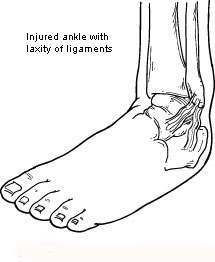
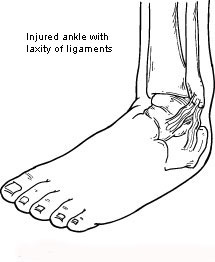
While rolling my ankle off of an 8″ curb, the lateral ligaments of the ankle were stretched out and had small tears made in them. The tears healed, but the ligament did not retract to its original size and remained lengthened. Thus, creating a lax ligament that was not able to perform its function of holding that ankle joint in place.

As a result, the other muscles and ligaments in my foot, ankle, even lower leg, had to work harder to compensate for the additional movement in the ankle joint. If those muscles and tendons became over-worked, then my knee and my upper leg and my hip became out of alignment slightly and those muscles and tendons tried to compensate for it as well. See how the problem spreads?

The goal with the chiropractor was to strengthen the muscles around the ankle and get rid of some of the scar tissue. So physical therapy began, with minor exercises to improve my range on motion. For two weeks, it hurt and nothing improved.

Then the chiropractor went to a seminar on ankle injuries. Next time I saw him, he took hold of my feet and felt all the bones and their placements. Most of the bones in my left were out of alignment (comparing it to my right). He went to work to set everything back. Yes, he literally popped my talus, my arch, my toes, even my knee, and to my shock my lower back. It hurt some and throbbed as usual afterwards. However, the next day, I had no pain in my ankle, knee, or hip!! It was a miracle.

I went to the chiropractor one or two days a week, doing the physical therapy and getting realigned. If I didn’t do anything too strenuous, the ankle stayed in place for about a week. I walked for exercise during this time, and went from 20 minutes to 50 minutes before rolling the ankle. It was a huge improvement. However, despite wearing an ankle brace, I”d still roll my ankle walking on a flat surface. By January of 2014, five months after seeing the first surgeon and doing physical therapy, I thought it was about time to get a second opinion and explore my options.

The Injury: Back Story

Well I had every intention of starting this blog on a new training regime prepared to share workouts and dinner recipes. But the ankle sprain that I was waiting and re-waiting to heal and get better never quite did. So I’m afraid I will have to start this running blog in a cast, unable to run. And trust me, this is progress.

I sprained my ankle (rolled my left ankle outward and scrapped the ground with it) during a 5k, in May 2012. Yes, I am now writing this in February 2014. It has taken almost 2 years to identify the problem and determine a solution. I really don’t want a single runner out there having to go through that. So here’s to learning from someone else’s experience.

After spraining my left ankle about 1 minute into the race (and finishing it of course like a dunce), I stayed away from ankle rolled outwardrunning about 3 weeks. I did not see a doctor. I began running with or without a brace, and upon the start of some interval training, felt my arch collapse. I ran sparingly and raced twice until August 2012. By this time, my knee was killing me, and if I ran in a way that helped my knee, my ankle was killing me. It was time to see a doctor.

I’d never gone to see a doc for a sports related injury, so I went to my General Practitioner and had them recommend someone: it was a surgeon that specialized in knee and shoulder surgery and had a background in Sports Medicine. I’ll refer to him as Dr. Knee. Dr. Knee diagnosed me with plantar fasciitis, achelies tendonitis, shin splints, and a small stress fracture in my tibia. 6 weeks off from running. Then rehab. Rehab helped a lot. Started running, and barely made it for the Army Ten Miler in late October. I did so well, not only did I finish, I averaged about 7:30min/mile pace. Overly ambitious, I ran two days afterwards and bam, pain in knee and ankle.

The weeks and months that followed were nothing but a series of cycles between being injured and running a little. I just kept getting hurt and spraining that ankle. My dad (an avid runner for over 40 years) suggested that my new hip pain and knee pain, were all derived from my ankle. I went back to see Dr. Knee, who did xrays and an MRI on my knee, only to find no issues. Then I asked him to consider my ankle as a source of the knee pain, and I had an ankle MRI end of July. Again, he said there was nothing to be found. Slightly disheartened, I began running again, slowly.

Less than a week later August 3 of 2013, I sprained my ankle for the 7th time. I stopped running and decided not to run again until I figured things out.

Welcome to the World Void of Gluten

Light Than Air Chocolate Cake from Gluten Free Mommy

Whether it’s an allergy, an intolerance, or Celiac disease, you are unable to consume anything that has the protein gluten in it. That doesn’t sound so bad, right?

Right, until you realize that gluten is what gives elasticity to dough, helps baked goods rise, thickens sauces and broths, used as an additive in foods with low protein, and a host of other uses. You find out you can no longer eat: most cereals, breads, crackers, chips, bagels, muffins, cakes, brownies, pies, pastries, buns, rolls, tortillas, pastas,  pizza, gravies, soy sauce, salad dressings, bar-b-q sauce, instant rices, frozen food entrees, fast food, imitation meat products, most types of candy, and the list continues. And because this little protein can be found hiding under several names, you get to spend hours reading labels at the grocery store, telling your co-workers no, you really can’t have a slice of the birthday cake,  lying in bed wondering if you remembered to check your toothpaste, and asking the waiter, can I please see the ingredient list for your marinade? Suddenly you feel your food choice realm has just shrunk significantly.

Yes, your post-gluten world will not be the same as the one you were living. Grocery stores will seem to shrink in the number of items you can even consider purchasing, the list of restaurants you go out to seems to have evaporated, the standard carbohydrates you used to refuel and pre-fuel before running will need some serious adjustment, and you don’t know where to begin. It can be overwhelming and even depressing at first, but please don’t be discouraged.

You will find there are still thousands of things you can eat and almost always you can find a way to create your most beloved gluten-food in a gluten-free version. And if you look at that list again, you will find that rules out a lot of unhealthy options. Going gluten-free will be the best thing for your body, and you will eat healthier as a result. That’s two huge positive benefits that outweigh even the best slice of cake.