
Gluten Free Alcohol

Well folks it is Labor Day weekend and that means it’s time to unwind, relax, and have a little fun. So what better topic than to figure out what we will be drinking this weekend?

Gluten free alcohol is a mixed topic (pun fully intended). Some drinks are obviously not gluten free, like beer, but when it comes to liquor, there is a bit more a debate. Below is the basic breakdown of your major alcoholic beverages:

Beer

What’s in it: Beer is primarily made of water, hops, yeast and malted barely. There are lots of other fun things that can be added, but the basic ingredients means is beer not gluten free. Sadly this will include things that are “beer battered” or soaked in beer (mmmm beer brauts!).

How’s it made: Beer is made by malting the grains, those are then steeped in water brought to a boil, hops are added, then it’s stored in a cool place with added yeast. At this point the beer is flat, so it’s bottled where the CO2 is formed over weeks or months, then it’s ready to drink. (For you beer lovers, I hope I didn’t butcher the process too badly). Cross contamination is likely if the equipment is shared.

Is it Gluten Free: No, with a few special exceptions. In general, beer is not safe for those with Celiac Disease. There are some beers that are gluten free, and they fall into two categories: Gluten Removed Beer and Gluten Free Grain Beer. The gluten removed beer is made from grains containing gluten and through processes the gluten is removed. I have always gotten sick off this kind of beer. For people with Celiac Disease, I don’t recommend this type of beer. I do recommend gluten free beer that is 100% gluten free ingredient based. These beers are made using different grains, such as rice, or millet. The taste is different, but some are still very good.

Continue reading “Gluten Free Alcohol”

Prosciutto and Melon with Caprese

Well we have a holiday weekend coming up and even though it’s COVID, there should be some gatherings going on. Whether you will attend a Skype BBQ or maybe get to host a live one in your own backyard, chances are there will be food to celebrate.

Now I don’t know about you, but I feel like appetizers can be tough done “gluten free.” Either there are dips and spreads that are probably cross contaminated, or there is something delicious-smelling that is breaded or served on crostini. Shucks. When invited to BBQ or party at someone else’s home (where there might be strangers and not everyone will be good about cross contamination), I try to bring a gluten free appetizer. And one that is 100% gluten free so no one decides to dip their pretzel into it. This sometimes poses a challenge.

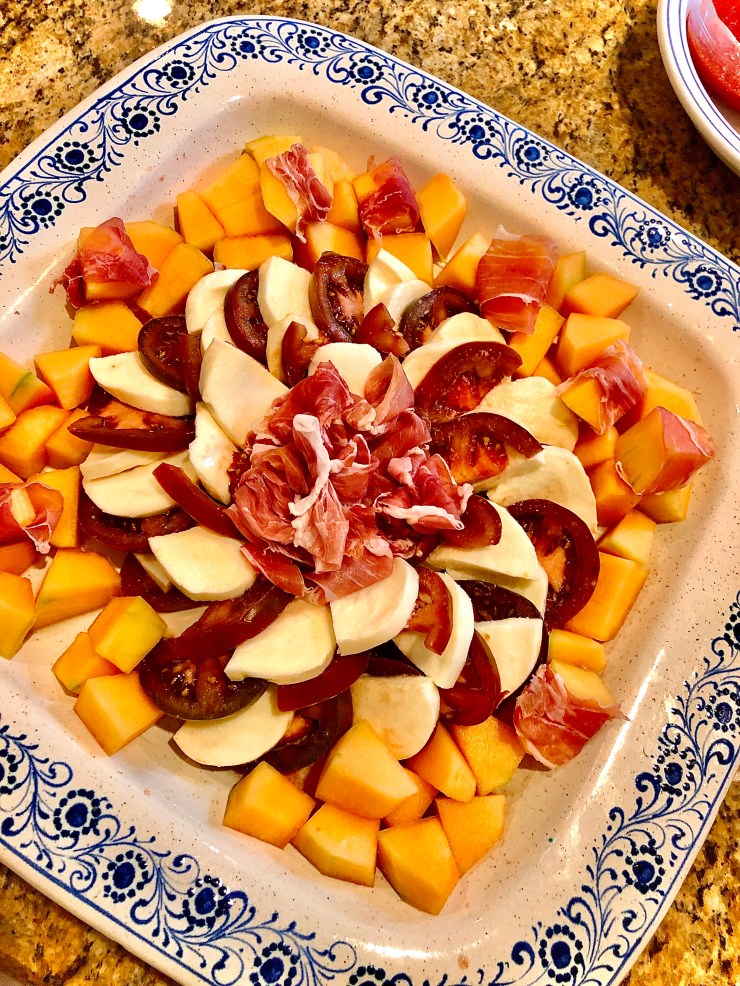
So when I find a good one, that tastes good, looks pretty, and dare I say, may even posses some nutritional value, I bookmark it, photograph it, and cherish it. Today I am happy to share a very easy appetizer: Prosciutto and Melon with Caprese Salad

Continue reading “Prosciutto and Melon with Caprese”

First Dates done Gluten Free

Oh the wondrous world of dating. It is full of highs and lows, and ups and downs. And no matter how you met the other person at some point, title or not, there will be a “first date.” The first date raises so many questions: how do we make a decision together, how does the other person reach a decision, where will we meet, what will we do, what time works best, what to wear, what on earth are you going to talk about, or more important what are you NOT going to talk about.

First dates can become the beautiful story folks share at their wedding reception that are so sweet, it leaves the entire audience a little dewy-eyed and feeling magical. Or, they can be so awful and terrifying that they make you question the good of humanity, like how can so much crazy be walking around, freely out there? It doesn’t matter if you were friends first, meet via an ap, or were set-up by your mothers, first dates come with their fair amount of anxiety. So let’s compound it by having a serious digestive disease, shall we?

Continue reading “First Dates done Gluten Free”

Gluten Free Basics: Food Types to Enjoy and to Avoid

Going gluten free means watching out for wheat, barely, and rye in our foods (and drinks), but let’s look at some basic types of foods that are gluten free in their natural form:

  • Fruits
  • Vegetables
  • Potatoes
  • Rice
  • Beans
  • Meat
  • Milk
  • Yogurt
  • Butter

The key here is “in their natural form.” Going to the butcher shop and selecting a steak, that is naturally gluten free. Going to the Whole Foods counter and asking for the steak tips in teriyaki marinade, that is not natural or gluten free. Steak doesn’t naturally come marinaded (at least not in this world), and the marinade here most likely contains soy sauce (more on this in a minute). Foods that are left in their original form, from nature, are usually safe to eat. So dried beans in a bag are probably okay, but beans in a can will contain other ingredients may not be safe.

Continue reading “Gluten Free Basics: Food Types to Enjoy and to Avoid”

Gluten Free Basics: Cross Contamination

You have some idea about what it is that you need to watch out for to eat gluten free food. But it isn’t safe just yet. PUT DOWN THE FRENCH FRY. I know, I know. I get how hard it is to resist, but let me explain.

Making sure the food is gluten free is a two part equation:

Gluten Free Ingredients + No Cross Contamination = Safe To Consume 

Gluten free ingredients:  WHAT is in your food/ drink?

Cross Contamination: HOW is it made?

Cross contamination is just what it sounds like, crucifixes infect eachother. No, kidding (I am not a heretic, please don’t be offended). But the idea behind one thing “infecting” another is legitimate. For example, let’s say someone made a sandwich for themselves and now they are making your gluten free sandwich. They pull out your gluten free bread, place it on the cutting board, dip the knife into the mayo, add a little mustard, slice the cheese, toss on some lettuce, and add turkey. Everything they used was gluten free so what’s the deal? Let’s break down the process a little more:

Continue reading “Gluten Free Basics: Cross Contamination”

Gluten Free Basics: Avoid Wheat, Barley, Rye, and Malt

Like most things in life, we learn more from what we don’t want than what we do. This same rule applies to everything you will eat, drink, put on that face, and in that beautiful mess of hair on your head. Think I am kidding? Do you want to spend 5 hours throwing-up in your wedding dress? I didn’t think so (that story will come in a later post). 

Knowing what is safe for you to consume, is all about knowing what to avoid. This means you are going to become an expert label-reader. Even if you already read labels, this becomes a gargantuan task. If you have never looked at a label in your life, let’s just say I cried a few times in the grocery store upon first being diagnosed. Because it can be so frustrating and time consuming. Just start small, and manageable. And do not beat yourself up for making a mistake here and there. 

I was a healthy eater, but didn’t pay too much attention to labels. Now, I read it thoroughly, and not just for gluten. It has taught me to watch out for other things that I want to control: is the MSG in that worth it? that has how much fat? huh I didn’t realize that this had such little sugar? 

Continue reading “Gluten Free Basics: Avoid Wheat, Barley, Rye, and Malt”

It’s Been Too Long

I haven’t written in ages, and that’s because of all the injuries. Well, really all the surgeries: ankle surgery in February 2014 and knee surgery in December 2014. I felt I had no right to write a blog about running when I couldn’t run. But as someone dear to me pointed out, “You can’t just stop writing because of that, that’s ridiculous.” Direct but true.

The more I thought about it, the more I realized people tend to come to me when they were injured: to figure out what was causing the pain, determine the injury, could they still run on it, how do you rehab it, how can you stretch your IT band? All those questions have a place here. I can’t tell you how many hours I spend looking up stuff, going to doctors, buying books, doing physical therapy, and figuring out everything through trial and error.

Not to mention, I haven’t stopped eating. This blog is also about celiac disease. I am still cooking and baking and going out to restaurants and traveling. And I still have celiac disease and continually learn more and more about it, finding new products or books or blogs that help me. And the occasional oops that always occurs.

Then I recalled the most important little thing we runners have in common: mind over matter. Running is sport that requires you to use your will and your drive to push yourself to places that your brain tells you you cannot go. If you haven’t ever experienced this yet, you will, just give it time and don’t give up. It also becomes a source of stress relief, for all the things we face in life. It’s our “me” time. Its the place we go to reflect on the day and about life overall. I have made some of my biggest decisions and had some of my greatest revelations on my runs.

Trouble is, when you are injured, oh jeez, you have to figure out a new venue for all of these things and it is not easy. You feel like you lost your inner peace, the one thing you always felt progress in, and even your friend. Yes, when I can’t run, I get really discouraged. It is a struggle. It sounds trite to those who don’t understand running like this, but I can assure you, if you lost your coping mechanism and the reliable thing that made you feel good about yourself, you’d hit a wall as well.

Ultimately I forgot. When you are injured, that’s the time you need encouragement the most. Whether it’s the shin splits that has you benched for a month, the sprained ankle that made you miss your half marathon, or the debilitating news of surgery and months of physical therapy afterwards. It’s when you take one step forward and two steps back on that uncertain road to recovery. That’s when we need to know we are making progress, we have to take it slow, and we will get back to what sets our hearts on fire (or at least mine): running.

The Surgery: Under the Knife

I’m just going to give the rundown on what I experienced and hopefully it will give you an idea of what to expect if you have ankle ligament reconstruction surgery (*Please note: check with your doctor on all procedures and recommendations):

Someone has to be present the whole time so the surgery center ensures you will not drive yourself home. So my family and I arrived at the outpatient surgery center at 9am and full out paperwork. They called me back about 9:30am, while my family waited in the waiting room (to be called back later). They took me to a nurses station to be weighed, asked me what surgery I was having and which ankle ( they ask this a lot) and i asked for one last bathroom break.

I followed the nurse down a hall with lots of bed bays with a curtain front. She took me to my own bay and asked my name and birthdate and surgery questions again. Then I had to get undressed, put on a gown, and place all my belongings in a plastic bag they provided. I laid down on the bed and waited for the nurse to return. She started my IV (stuck me with a needle that was connected through a tube to a bag and taped it to my forearm).
Then another nurse came in, asked me about the surgery, and took my left ankle. She placed a pad underneath it and washed it with an organe-ish soap to have it clean for surgery (leaves a yellowish residue).

I then met an anesthesiologist, who asked about my surgery again. He asked if I wanted a nerve block (which my Dr. recommended). Basically this dulls the nerve that goes down into your lower leg and foot. This was a great thing because it enabled me to sleep for two days after surgery before I felt the real pain. I agreed to have it done, and he left to get his things prepped.

Next, the anesthesiologist’s assistant came in and began setting up equipment. The anesthesiologist returned and the nurse over my IV gave me something to relax. Immediately I felt drowsy and things got a little fuzzy. The anesthesiologist, using a marker, went up from my knee, to the outer thigh and marked the injection spot for the nerve block. A pinch lasted about five seconds as he injected the nerve block in with a large needle. It felt sore, but the medicine they gave me through the IV had dulled my senses.

At this point, the first nurse went to bring my family back for one last hello. I was starting to become more out of it at this point. After about three minutes, the family had to go because the anesthesiologist was back and started to hook me up to the big drugs (anesthesia).

I recall lying on the bed and being wheeled down a hall, through a set of double doors, and eventually to the surgery room. I think they asked me again what my surgery was and which leg (which is like going to happy hour then asked to calculate your annual income taxes). I then had to lift myself off the bed and scootch onto another “bed” (operating table). I know I saw my surgeon, she said hello. Then the anesthesiologist said he was giving me something, and I started to say, I think I feel it now, but only made it to “feel” before going unconscious.

Time passes, I have surgery ……

When I woke up, it was in a corridor with lots of other beds and patients starting to wake. My left foot felt snug, and appeared to be wrapped in a ace bandage with lots of padding underneath It was really a split cast: they cast the leg, then cut it all the way around it so the cast is literally split in half; the cast is tightened or loosened by an ace bandage wrapped around it.

A nurse came over and asked how my pain level was. I said, I didn’t really have any. She said when I had to wait a little while and when I felt awake enough, I could leave. I still felt half asleep and very wobbly 30 minutes later as a nurse unhooked me from the IV. Then they helped me get dressed, carefully getting my pants around my cast.

Then a wheelchair was brought to my bed, and a nurse wheeled me to a room where my family was waiting to take me home. A nurse went over everything that occurred during surgery as I was waking up, and I couldn’t remember any of it. So I was able to ask my family how it went (since the surgeon had spoken to them earlier after my surgery). Then the nurse wheeled me to the pick-up area and helped me into the car. I slept the remainder of the day and tired to have someone put ice on my ankle every 30 minutes.

Homemade Gluten Free Hoisin Sauce

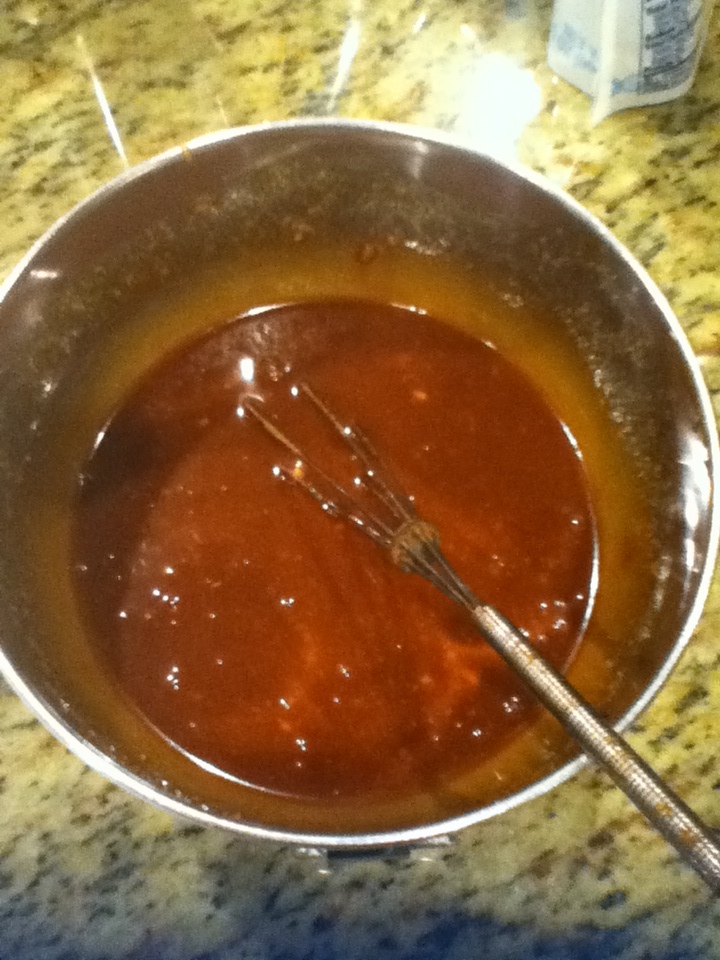
20140315-201217.jpg

This recipe was very easy and tasted great! A recipe I had for Bourbon Pork Tenderloin called for Hoisin Sauce, which I thought, great, another ingredient I don’t have and will not be able to find on a grocery store shelf. So, to Google it was, and I adapted this recipe from Food.com

Homemade Gluten Free Hoisin Sauce

  • 4 Tbl gluten free soy sauce
  • 2 Tbl gluten free all natural peanut butter
  • 1 Tbl molasses (or substitute honey)
  • 2 tsp seasoned rice vinegar
  • 1 finely minced garlic clove
  • 2 tsp sesame seed oil
  • 1 tsp Chinese hot sauce, to taste (I used  sweet chili garlic sauce)
  • 1/8 tsp black pepper

Directions:

  1. Combine all ingredients in a small mixing bowl.
  2. Mix well with a whisk until well blended.

Yeild: 3/4 Cup

Please note: items in red are ones that you will need to make sure they are gluten free, as the common variety might not be.


The Solution: Lateral Ankle Ligament Reconstruction and Arthoscopy

January 2014: Second and Third Opinion from another Orthopedic Surgeon

After six months giving physical therapy a try and doing absolutely no running, my left ankle still wasn’t holding-up. I went to see another surgeon (we’ll call him Surgeon A), this time more prepared for the answer he gave. He went through and did the same things as the previous surgeon: another round of xrays and standing on one leg, etc. He also came to the same conclusion, that although no issues showed up on any of the tests, I probably needed surgery on my ankle to make it better.

Surgeon A had a lot of experience and was highly sought after in my town, but he described the surgery to me as he was speaking into a tape recorder just under the speed an auctioneer would. In the middle, there was something said along the lines of, “and the patient understands there is a metal suture that I will not remove post op.” I stopped him right there and asked if that meant that a piece of metal would be lodged in my ankle for the rest of my life. He said, yes, but it’s no more metal than that of an earring. Post op, I heard him dictate that I was to be in a non-weight bearing cast for three weeks, then a weight bearing cast for three more weeks, then a boot.  Despite not feeling comfortable to ask more questions, or go over what exactly the surgery entailed again more slowly, I went ahead and scheduled a date two months later for surgery (his first availability). I asked the nurse at the check-out counter what exactly the type of surgery I was going to have preformed: ankle ligament reconstruction and ankle scope. And off to Google it was to figure out what those meant.

After much time on the internet, I became more familiar with the procedure but still had questions and concerns. The first surgeon I saw, had recommended another surgeon if I decided later on that I wanted to do surgery. So, I decided for one last (my third) opinion from another orthopedic surgeon (Surgeon B).

Surgeon B was new to practice – only one year out of finishing her residency. She did not do any further xrays, after asking if anything had really changed since my last set of xrays, and I said no. She asked me to explain what happened and what my problems were and she listened. She sat me down on the table and took my ankle in her hand. She then began twisting and turning it, and then she pulled my ankle out and down. I heard a small pop. She did it again, and again another pop. She then explained that she could pull my ankle out of joint very easily and that was not normal. Believing more in clinically what she found than in test results, she explained how my ligament had become too lax and could not support the ankle joint staying in place all the time, and went through what surgery would do.

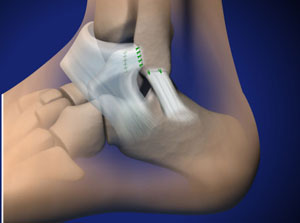
From my understanding, she would use a small camera to examine the inside of my ankle joint. This was to ensure that no small pieces of cartilage had chipped off at any point from all my ankle sprains, and was called an arthroscope. Thenlateral ankle ligament reconstruction, she would cut my lateral ankle ligament and suture it back together and take a portion of the ligament and suture it to the bone (with the placement of a small metal screw that would remain in my ankle). There would be a lot of scar tissue that would form around the cut and it was one time that scar tissue was a great benefit because it would help to tighten the ligament even further. I would be in a cast and be non-weight baring for six weeks. After this, if everything went well, I would be placed in a cam-walker (boot) and start physical therapy. If everything went well, I could start running, very slowly, in three months. She also stressed that the surgery would be necessary  (even if I waited ten years) to prevent or stop any arthritis from developing in the ankle due to the additional movement my ankle joint experienced with the lax ligament. Video of Lateral Ankle Ligament Reconstruction

Night and day, was my initial thought. Now, I understood things. I had a lot of reservations about which surgeon I should pick to perform the surgery. Both surgeon recommended the same surgery and procedures. Surgeon A had a lot of experience but didn’t make me feel comfortable. He also had a less conservative approach to casting after surgery. Surgeon B had less experience, but was fresh out of medical school and current on the latest and greatest information. She also explained things clearly, permitted me to ask questions, and ..drum roll… she listened.

So I went with Surgeon B. I cancelled my appointment with the other surgeon, and was set up for surgery just two weeks later.

A great explanation of the procedure, along with very helpful images, can be found in this article:

Surgical Considerations in the Treatment of Ankle Instability by Judith F. Baumhauer and Todd O’Brien