
January 2014: Second and Third Opinion from another Orthopedic Surgeon
After six months giving physical therapy a try and doing absolutely no running, my left ankle still wasn’t holding-up. I went to see another surgeon (we’ll call him Surgeon A), this time more prepared for the answer he gave. He went through and did the same things as the previous surgeon: another round of xrays and standing on one leg, etc. He also came to the same conclusion, that although no issues showed up on any of the tests, I probably needed surgery on my ankle to make it better.
Surgeon A had a lot of experience and was highly sought after in my town, but he described the surgery to me as he was speaking into a tape recorder just under the speed an auctioneer would. In the middle, there was something said along the lines of, “and the patient understands there is a metal suture that I will not remove post op.” I stopped him right there and asked if that meant that a piece of metal would be lodged in my ankle for the rest of my life. He said, yes, but it’s no more metal than that of an earring. Post op, I heard him dictate that I was to be in a non-weight bearing cast for three weeks, then a weight bearing cast for three more weeks, then a boot. Despite not feeling comfortable to ask more questions, or go over what exactly the surgery entailed again more slowly, I went ahead and scheduled a date two months later for surgery (his first availability). I asked the nurse at the check-out counter what exactly the type of surgery I was going to have preformed: ankle ligament reconstruction and ankle scope. And off to Google it was to figure out what those meant.
After much time on the internet, I became more familiar with the procedure but still had questions and concerns. The first surgeon I saw, had recommended another surgeon if I decided later on that I wanted to do surgery. So, I decided for one last (my third) opinion from another orthopedic surgeon (Surgeon B).
Surgeon B was new to practice – only one year out of finishing her residency. She did not do any further xrays, after asking if anything had really changed since my last set of xrays, and I said no. She asked me to explain what happened and what my problems were and she listened. She sat me down on the table and took my ankle in her hand. She then began twisting and turning it, and then she pulled my ankle out and down. I heard a small pop. She did it again, and again another pop. She then explained that she could pull my ankle out of joint very easily and that was not normal. Believing more in clinically what she found than in test results, she explained how my ligament had become too lax and could not support the ankle joint staying in place all the time, and went through what surgery would do.
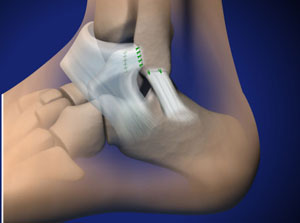
From my understanding, she would use a small camera to examine the inside of my ankle joint. This was to ensure that no small pieces of cartilage had chipped off at any point from all my ankle sprains, and was called an arthroscope. Then , she would cut my lateral ankle ligament and suture it back together and take a portion of the ligament and suture it to the bone (with the placement of a small metal screw that would remain in my ankle). There would be a lot of scar tissue that would form around the cut and it was one time that scar tissue was a great benefit because it would help to tighten the ligament even further. I would be in a cast and be non-weight baring for six weeks. After this, if everything went well, I would be placed in a cam-walker (boot) and start physical therapy. If everything went well, I could start running, very slowly, in three months. She also stressed that the surgery would be necessary (even if I waited ten years) to prevent or stop any arthritis from developing in the ankle due to the additional movement my ankle joint experienced with the lax ligament. Video of Lateral Ankle Ligament Reconstruction
Night and day, was my initial thought. Now, I understood things. I had a lot of reservations about which surgeon I should pick to perform the surgery. Both surgeon recommended the same surgery and procedures. Surgeon A had a lot of experience but didn’t make me feel comfortable. He also had a less conservative approach to casting after surgery. Surgeon B had less experience, but was fresh out of medical school and current on the latest and greatest information. She also explained things clearly, permitted me to ask questions, and ..drum roll… she listened.
So I went with Surgeon B. I cancelled my appointment with the other surgeon, and was set up for surgery just two weeks later.
A great explanation of the procedure, along with very helpful images, can be found in this article:

 Gluten Free Runner Gal
Published by